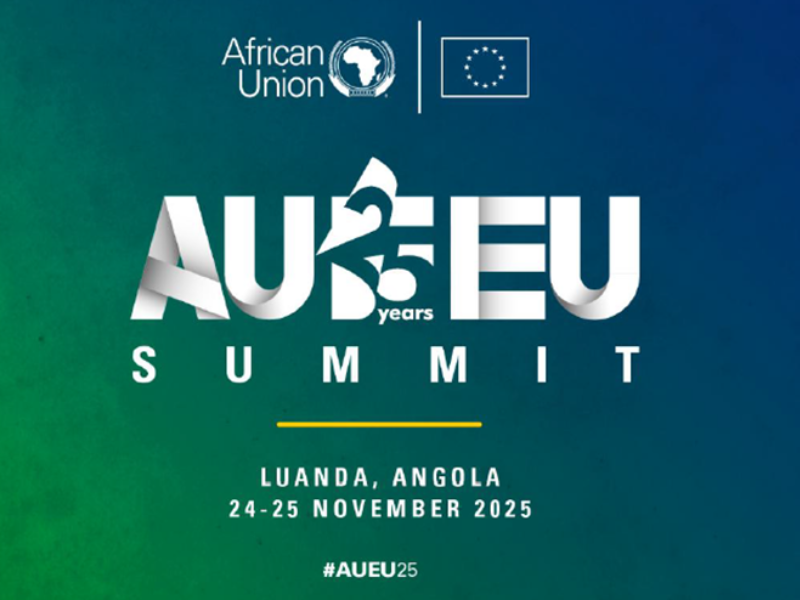
Fonte immagine Seventh African Union – European Union Summit | EEAS
Ufficio Policy Focsiv – Focsiv insieme a CIDSE ha firmato la dichiarazione della società civile africana ed europea consegnata ai leader in occasione del Vertice UA-UE del 24/25 novembre 2026 a Luanda.
Qui la sintesi
Come organizzazioni della società civile africana ed europea, esortiamo i capi di Stato e di governo dell’UA e dell’UE a fare dell’azione per il clima la massima priorità politica, inserendo giustizia, equità e responsabilità al centro del partenariato. La COP30 e il Vertice UA-UE devono essere strategicamente collegati per ottenere progressi reali per le persone e il pianeta. Chiediamo all’UA e all’UE di:
- Impegnarsi in un’azione climatica urgente e allineata a 1,5°C, realizzando l’Accordo di Parigi, l’energia pulita e a prezzi accessibili (SDG7), l’ambizione dell’Africa in materia di energia rinnovabile per 300 GW entro il 2030 e l’attuazione degli obiettivi energetici globali della COP28
- Triplicare le energie rinnovabili, raddoppiare l’efficienza energetica e abbandonare i combustibili fossili.
- Riformare i sistemi finanziari e del debito globali per sbloccare finanziamenti accessibili ed equi per il clima. Ciò significa sostenere una Convenzione quadro delle Nazioni Unite sul debito sovrano, aumentare i finanziamenti basati su sovvenzioni e concessioni, triplicare i finanziamenti pubblici per il clima entro il 2035, aumentare i finanziamenti per il clima ai Paesi in via di sviluppo ad almeno 1.300 miliardi di dollari all’anno e garantire l’accesso diretto ai Paesi e alle comunità africane.
- Adottare impegni vincolanti per l’eliminazione dei combustibili fossili in Europa, fine del carbone entro il 2030, del gas entro il 2035 e del petrolio entro il 2040; in Africa, nessuna nuova infrastruttura fossile oltre il 2025, con il sostegno di finanziamenti internazionali per una transizione energetica rapida e giusta. Il Vertice deve correggere il debole comunicato dei Ministri degli Esteri e affermare un futuro senza fossili.
- Riconoscere e sostenere la leadership dell’Africa per una giusta transizione, assicurando che i minerali critici alimentino l’industrializzazione locale, l’aggiunta di valore e la creazione di posti di lavoro, non i modelli di esportazione estrattiva. L’UE deve sostenere il trasferimento di tecnologie, la produzione locale, lo sviluppo delle competenze e i partenariati per l’innovazione per consentire un’industrializzazione verde equa.
- Aumentare i finanziamenti per l’adattamento e le perdite e i danni con obiettivi chiari, tempistiche prevedibili e un’allocazione equilibrata tra i pilastri climatici. Questi finanziamenti devono essere basati su sovvenzioni, essere aggiuntivi e accessibili, e devono riguardare l’acqua, i sistemi alimentari, la salute e le infrastrutture resilienti al clima, correggendo gli impegni ministeriali vaghi.
- Investire in soluzioni basate sulla natura e guidate dalle comunità, tra cui il ripristino degli ecosistemi, l’agroecologia, la riforestazione e i sistemi di allerta precoce, per proteggere la biodiversità, rafforzare la resilienza e garantire i mezzi di sussistenza in Africa e in Europa.
- Garantire una governance inclusiva e la responsabilità nella cooperazione UA-UE, creando ruoli fondamentali per la società civile, le popolazioni indigene, i giovani e le comunità nel monitoraggio dell’energia, della finanza e dei partenariati di adattamento, assicurando trasparenza e partecipazione significativa.
Il Vertice UA-UE rappresenta un’importante opportunità per costruire un partenariato trasformativo fondato sulla solidarietà, l’equità e la giustizia, che sia a favore delle persone e del pianeta, non del profitto.
Di seguito il Full Statement
As African and European civil society organizations, we issue this statement in the context of COP30, with the clear understanding that our demands are directed toward the upcoming AU–EU Summit. We see COP30 not only as a critical moment in the global climate negotiations, but also as an opportunity to build momentum and ensure that the AU–EU Summit, which will take place after COP30, rises to the challenge of the climate emergency. These two processes must be strategically connected if they are to deliver real progress for our peoples and our shared planet.
We welcome the AU–EU Summit as a defining moment to advance a just and transformative partnership between our continents. Yet we are deeply concerned that climate action is not being treated as a priority agenda item. Climate mitigation—including the urgently needed just transition to renewable energy sources and the phase-out of fossil fuels—adaptation to mounting climate impacts, and the handling of losses and damages remain marginal in the preparations for the Summit. This lack of prioritization was already evident in the weak AU–EU Foreign Ministers’ communiqué of May 2025, which failed to reflect the urgency of the crisis, as well as to recognise the costs of inaction or the economic benefits of the transition. The Summit must correct this by making climate action in all its dimensions the central priority, and by placing justice, equity, and accountability at the heart of AU–EU cooperation.
- Commitment to Paris Agreement and SDGs
Member states of both the AU and EU are critical signatories to the Paris Agreement and are legally-bound to deliver Nationally Determined Contributions (NDCs). These NDCs remain the central mechanism to raise ambition under the Paris framework, as affirmed in the recent Advisory Opinion of the International Court of Justice. By September 2025, countries were supposed to submit their new, third-generation NDCs.
The EU, however, has failed this fundamental test of credibility. Its new NDC was submitted two months late, and the additional time was not used to increase ambition. The 2035 target of a 66.25–72.5% emissions reduction introduces uncertainty and does not inspire high confidence that the EU is on a credible path to achieve the 2040 goal of a 90% cut. Such a lack of leadership undermines trust in the EU’s climate credibility and sends the wrong signal to African countries — nations already bearing the brunt of a crisis they did not cause. We call on the EU to make clear that, through a credible implementation package, it not only intends to reach the upper end of its target range but is determined to exceed it.
The upcoming AU–EU Summit provides a crucial opportunity to demonstrate readiness for ambitious implementation. The summit must translate commitments into tangible action — by accelerating NDC delivery across all sectors, strengthening multilateralism, and deepening cooperation between Africa and Europe. This cooperation must be explicitly aligned with the Sustainable Development Goals (SDGs), ensuring that climate action simultaneously advances energy access, poverty reduction, equity, and sustainable development. Only by connecting ambitious climate action with the broader development agenda can the AU and EU demonstrate credible leadership and ensure that the Paris Agreement delivers on its promise.
- Climate, Resilience & Adaptation
Africa and Europe face shared vulnerabilities—climate impacts, food insecurity, migration pressures, pandemics, conflicts, and inequality. The upcoming AU–EU Summit must place resilience, adaptation, and loss and damage at the center of cooperation, backed by concrete commitments and predictable support for African countries and communities.
Yet adaptation is conspicuously absent from the Summit agenda. While the EU emphasizes renewable energy and green industrialisation, it risks sidelining the urgent adaptation needs of African countries. This imbalance reflects eurocentric priorities that neglects priorities clearly articulated by the AU, most recently in the Addis Ababa Declaration. The Summit must correct this by making adaptation a central agenda item.
- Integration into development and national strategies: We expect the Summit to commit to the systematic integration of adaptation into agriculture, water, energy, infrastructure, and broader development policies. Adaptation investments must be aligned with African National Adaptation Plans (NAPs), NDCs, and development strategies, grounded in the Principles for Locally Led Adaptation (LLA), and co-designed with local communities, civil society, women, youth, and rural populations.
- Scaling up grant-based adaptation finance: The AU–EU Summit must commit to a substantial increase in grant-based adaptation finance to address Africa’s urgent needs, including water, climate-resilient infrastructure, health, sanitation, agroecology, equitable food systems, and nature-based solutions. Finance must be predictable, additional, and non-debt creating, with strong support for African-led initiatives at local, national, and continental levels. This includes accelerating the Africa Adaptation Acceleration Program (AAAP), targeting $50 billion by 2030 to strengthen food systems, infrastructure, and urban resilience. Adaptation investments should also prioritise ecosystem-based solutions, including reforestation, ecosystem restoration, and agroecology, as well as inclusive early warning systems and local disaster risk reduction capacities. EU-supported initiatives, such as the Global Gateway, must explicitly mainstream adaptation and disaster risk reduction—areas that are currently neglected—while aligning with African priorities, strengthening local capacity, and ensuring meaningful impact for vulnerable communities.
- Global Goal on Adaptation and Loss & Damage
We call on the Summit to adopt a joint AU–EU position advocating for a robust operational framework for the Global Goal on Adaptation (GGA) at COP30, including clear, equitable Means of Implementation—finance, technology transfer, and capacity-building—to make GGA targets achievable. The EU must also commit new, additional, and predictable resources to the Loss and Damage Fund, with direct access for affected communities, and support the launch of a UNEP-hosted Loss and Damage Gap Report under the WIM review process.
- Renewable Energy & Just Transition
Energy is at the heart of Africa–Europe cooperation, yet current commitments fall short of addressing the urgency of the climate crisis and the scale of Africa’s renewable energy ambitions. The upcoming AU–EU Summit must go beyond general affirmations and deliver binding, actionable commitments that advance global climate goals, secure Africa’s transition to renewables, and tackle energy poverty. This requires a clear Summit decision that aligns with the 1.5°C pathway, respects social justice principles, and prioritises Africa’s development priorities.
- Global energy goals and African renewable energy ambitions: The AU and EU must agree on binding commitments to deliver on COP28 global energy goals and Africa’s own ambitions, as outlined in the Nairobi Declaration and reaffirmed in the Addis Ababa Declaration of September 2025. Africa has made its priorities clear: expanding renewable energy capacity from 56 GW to 300 GW while ensuring energy access for the 600 million people still in energy poverty by 2030, and aligning with Africa’s national and regional development priorities.
- Fossil fuel phase-out: The AU and EU must adopt binding commitments to phase out fossil fuels, with timelines that reflect their different responsibilities and capacities. For the EU, an equitable approach requires phasing out coal by 2030, gas by 2035, and oil by 2040—consistent with its historical responsibility and financial capacity. The AU, meanwhile, must be supported to avoid locking into fossil-dependent pathways, with a clear commitment to no new fossil fuel infrastructure beyond 2025 and international support to rapidly scale up clean energy access.
- No fossil fuel investments: The EU must urgently end public support for fossil fuels, including support provided through development banks and export credit agencies (ECAs), and redirect them toward renewable energy, aligning with just transition principles and avoiding socially regressive impacts. Public spending, including subsidies and investments, must be explicitly prohibited from supporting fossil fuel infrastructure, including production, processing, distribution, storage, and combustion of fossil fuels. Additionally, the EU and AU should adequately regulate the private financial sector to align with the goals of the Paris Agreement. This means not only offering “green incentives” but also introducing stringent safeguards and penalties for climate-damaging activities.
- People-centred and gender-responsive just transition: The EU and AU must commit to a fossil-free future, ensuring that all investments support a just and sustainable energy transition. A just transition must embed human rights, gender equality, intersectionality, and labour standards in line with ILO guidelines. They should also support the establishment of a robust institutional arrangement within the UNFCCC to support the Just Transition Work Programme (JTWP). and accelerate a holistic just transition across all sectors and regions. This arrangement should serve as a platform for dialogue, knowledge exchange, implementation support, and accountability, ensuring the meaningful participation of governments, civil society, Indigenous Peoples, and vulnerable communities. Financing and implementation should prioritise community-led renewable energy initiatives, the retraining of fossil fuel workers, inclusive social protection systems, and gender-responsive planning.
- Decentralised, community-based energy access: The AU and EU must prioritise decentralized, community-driven energy solutions that strengthen local capacity and resilience. Energy efficiency should be treated as a critical enabler: the greater the efficiency gains, the lower the demand for new energy, and the faster the fossil fuel phase-out. The Summit must prioritise addressing energy poverty for women and youth, ensuring access, affordability, and meaningful participation in decision-making for all marginalised groups.
- Regional power pools and AfSEM: The AU and EU must strengthen regional power markets and grid interconnections, including the East and Southern Africa Power Pools. This requires co-developing regional power pools and cross-border transmission infrastructure aligned with the African Single Electricity Market (AfSEM). Harmonised regulatory frameworks, removal of tariff and non-tariff barriers, and investments in interconnectivity and smart grids are essential.
- Green Industrialisation & Equitable Value Chains
Africa’s economic transformation depends on equitable industrialisation and fair participation in global green value chains. The AU and EU must reject extractive models that reduce Africa to a supplier of raw materials and instead commit to industrial strategies that keep value, jobs, and innovation on the continent. The EU–AU Summit must chart a bold course for Africa’s economic transformation through green industrialisation, ensuring the continent fully benefits from its natural resources and plays a central role in the global energy transition.
- Technology transfer, local manufacturing, and innovation: The EU must commit to equitable and transparent frameworks for technology transfer and intellectual property rights, alongside capacity-building partnerships that empower African states to locally manufacture and scale up green technologies such as solar panels, wind turbines, batteries, and green hydrogen equipment. Building on the outcomes of the Second Africa Climate Summit in Addis Ababa, leaders at the AU-EU Summit should recognise technology development and transfer as critical enablers for Africa to move from climate vulnerability to leadership. Investments in research and development (R&D), capacity building, and innovation can strengthen local expertise while supporting renewable energy infrastructure and clean technology solutions. This will allow Africa to move up the value chain, create skilled jobs, and develop homegrown technologies adapted to local contexts — ensuring long-term sustainability and competitiveness in global clean energy markets.
- Green minerals and fair value chains: Africa’s vast reserves of cobalt, lithium, copper, and rare earths are one cornerstone of the continent’s green industrialisation. African leaders have announced a continental Green Minerals Strategy and the creation of a coalition of mineral-producing countries to ensure that extraction drives inclusive growth, local beneficiation, and job creation, supported by transparent governance, community consent, and strong ESG standards. The AU and EU Summit must affirm these priorities, ensuring critical minerals fuel African industrialisation, not just Europe’s supply chains.
- Finance, Debt & Taxation
No meaningful climate action is possible without transforming the global financial system. The AU and EU must work together to ensure fair, accessible, and effective finance that supports mitigation, adaptation, resilience, and loss and damage. Current financial flows are inequitable and inadequate — leaving Africa with high borrowing costs, rising debt burdens, and only 2% of global renewable energy investments despite its vast potential.
- Urgent financial reform and debt justice
The AU and EU must champion structural reform of global financial and economic systems, including the establishment of a UN Framework Convention on Sovereign Debt to ensure fair, timely, and sustainable debt resolution. The recent G20 Ministerial Declaration on Debt Sustainability (October 2025) made important commitments, including supporting low- and middle-income countries to address debt vulnerabilities, enhancing debt transparency including from private creditors, promoting crisis-resilient debt clauses and voluntary debt swaps, as well as strengthening the implementation of the Common Framework for Debt Treatments beyond the DSSI.
Building on these commitments, the AU and EU should support recommendations from the Expert Review on Debt, Nature and Climate, the Jubilee Commission, and the African Expert Panel on the Cost of Capital. Lowering the distorted cost of capital is critical to unlock affordable financing for climate mitigation and adaptation. In addition to coordinated relief, clear incentives must be set for private creditors to participate in timely restructurings, and state-contingent debt instruments, such as climate-resilient debt pause clauses, should be scaled up. Structural reform must therefore include a UN Framework Convention on Sovereign Debt to fix persistent flaws in the global debt architecture and ensure timely, fair crisis resolution.
- Scaling up climate finance across all pillars
The New Collective Quantified Goal (NCQG) adopted at COP29 in Baku falls short of African demands. African Leaders reiterated in the Addis Ababa Declaration that climate finance is a legal obligation under the UNFCCC and Paris Agreement, not charity, and called for far greater ambition—particularly in grant-equivalent finance. Developed countries must double contributions by 2030 and triple them by 2035, scaling climate finance to developing countries to at least USD 1.3 trillion annually. Both sides should support a decision at COP30 for developed country parties to at least triple their collective provision of public climate finance for adaptation to developing country Parties by 2030, based on the Glasgow commitment to double adaptation finance by 2025. Finance must be balanced across mitigation, adaptation, and loss & damage, with urgent replenishment of the Green Climate Fund, Adaptation Fund, and the Loss and Damage Fund. EU member states should scale up their budget contributions and ensure these resources are additional to existing Official Development Assistance (ODA), including, through a bigger EU external action budget governed by a 50% climate and environment spending target. Global Gateway initiatives would benefit from greater transparency, should support country and community ownership, target high risk and hard to decarbonise sectors of the economy and deliver positive development impacts to ensure additionality. - Fair access to finance: Access to finance remains a major barrier—particularly for African communities, small enterprises, and medium-scale projects. For example, Africa currently receives just 2% of global renewable energy investment, yet leaders in Addis called for this share to rise to at least 20% by 2030, delivered primarily through grants and concessional finance rather than debt-heavy models. Funding must enable direct, affordable access, including for adaptation and resilience needs in agriculture, water security, and early warning systems. This requires more grants, concessional finance, better risk mitigation, removal of non-tariff trade barriers, and elimination of geopolitical or commercial conditionalities. Comprehensive regulatory reforms on the ground are also crucial to reduce investment risk and build investor confidence. The European Investment Bank (EIB) should strengthen its role as a climate and development bank, scale up its adaptation target, work in partnership with African development banks, and deploy its technological capacity and guarantees to unlock greater investment in Africa’s clean energy and climate-resilient future.
- Innovative financing mechanisms
To mobilise new resources, the AU and EU should jointly advance solidarity levies on aviation and shipping, progressive wealth and fossil fuel taxes, and the redirection of fossil fuel subsidies. While the Addis Ababa Declaration softened earlier calls for solidarity levies (Nairobi Declaration), such mechanisms remain essential for building reliable sources of adaptation and loss & damage finance. The AU and EU should also ensure that negotiations on a new UN Convention on International Tax Cooperation strengthens developing countries’ ability to raise revenues, and encompass progressive environmental taxation in line with the Polluter Pays Principle and CBDR-RC.
- Civil Society Engagement and Participation
Civil society, including women and youth organizations, plays a vital role in holding governments accountable, ensuring transparency, and representing diverse public interests in AU–EU cooperation, in a context of shrinking civic space in both regions. Yet current engagement mechanisms remain inadequate, opaque, and exclusionary.
The CSO/Youth Event, held just days before the AU–EU Summit, is emblematic of these shortcomings. Its timing severely limits participants’ ability to substantively influence summit outcomes, reducing the event to a symbolic consultation rather than a meaningful platform for input. Furthermore, the selection process for participants is neither transparent nor inclusive. Both the AU and EU nominate 50 CSO and youth participants, but there is no publicly available information on the criteria, process, or timeline. This opacity raises serious concerns that only non-critical actors or business-aligned representatives are selected, sidelining independent, grassroots, or advocacy-focused voices that challenge prevailing agendas.
Beyond the summit, there is currently no formal mechanism for civil society to engage with the AU–EU partnership, including critical sectors such as energy. The lack of institutionalized engagement means that civil society cannot monitor implementation, provide independent oversight, or hold decision-makers accountable.
We call on the AU and EU to:
- Establish formal observer roles for civil society, including youth, in all AU–EU partnership platforms, particularly in sectors like energy, climate, and finance.
- Ensure transparent and inclusive selection processes for all CSO and youth consultations, with clear eligibility criteria, timelines, and reporting mechanisms.
- Schedule consultations well in advance of summits, allowing meaningful input into agendas, policy recommendations, and negotiating positions.
- Guarantee that independent, critical voices—including grassroots organizations, advocacy groups, and marginalized communities—are prioritized over non-traditional or business-aligned actors.
Conclusion
The AU–EU Summit is a historic opportunity to reshape our partnership on the basis of equity, solidarity, and justice. We, African and European civil society organizations, reaffirm our commitment to actively participate in shaping a just transition. Our voices must be heard in decision-making processes to ensure that this partnership delivers for people and planet—not for profit. We urge leaders to adopt a bold Summit communiqué that aligns energy, climate, finance, and industrialisation commitments with the urgent needs of our time, and sets a course for a resilient, sustainable, and just future.