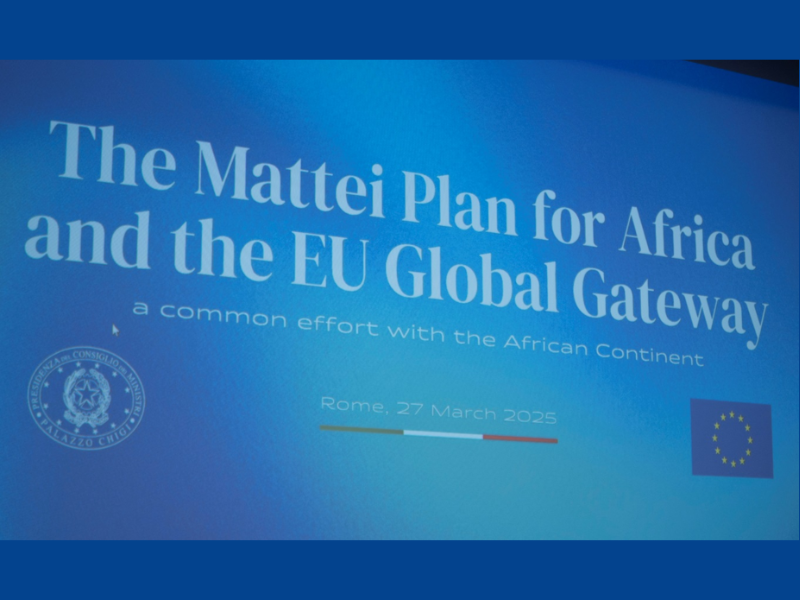
Fonte immagine Piano Mattei, evento Italia-Ue per rafforzare la cooperazione con l’Africa | www.governo.it
Ufficio Policy Focsiv – Recentemente è stata presenta la terza relazione annuale sullo stato di attuazione 2026 sul Piano Mattei per l’Africa, trasmessa al Parlamento | www.governo.it, qui la relazione ES0334. Sul Piano Mattei abbiamo già scritto più volte, recentemente in occasione di un seminario su Un Piano Mattei verde? – Focsiv.
In questo articolo abbiamo fatto una semplice verifica di quante volte appaiono alcune parole o varianti vicine nella relazione al Parlamento, che segnalano l’attenzione verso principi, temi e attori. Sono apparse le seguenti occorrenze.
Alcune parole su principi di orientamento sono assenti o sono citate pochissime volte: sono assenti Diritti umani, Stato di diritto, mentre la Democrazia è citata solo 2 volte.
Riguardo la relazione del Piano Mattei con impegni multilaterali è assente il riferimento all’Agenda 2030, ma sono menzionate 12 volte le Nazioni Unite e due volte gli SDGs, mentre vi sono numerose citazioni di altri consessi come l’Unione Africa, il G7 e il G20.
Il coinvolgimento della società civile locale è indicato solo 15 volte, mentre appare 97 volte un concetto come quello di Nazioni, concetto che risulta abbastanza fuori luogo riguardo gli Sati africani, essendo molti multietnici. Forse era più conveniente utilizzare la parola Stato (31 volte).
Riguardo i temi vi è una schiacciante prevalenza dello sviluppo e approvvigionamento energetico citato ben 157 volte (di cui 10 volte le rinnovabili); di agricoltura e alimentazione (137), infrastrutture (99), acqua (97), formazione (92), salute e sanità (68), secondo le direttrici del Piano, mentre minore attenzione è rivolta a materie strategiche e minerali critici (5), inclusione sociale (2 volte); parità di genere, disuguaglianze di genere ed empowerment femminile (8); donne e giovani (3); giovani (11); disabilità e persone con disabilità (5).
Gli standard sociali ed ambientali sono citati solo 1 volta (ESG) e la valutazione sociale e ambientale nessuna,.
Ovviamente l’analisi testuale ha un valore conoscitivo limitato, essendo più importante entrare nel merito delle citazioni e delle azioni, ma comunque segnala l’attenzione dedicata ad alcuni concetti, e quindi, molto probabilmente rivela l’effettiva significanza, priorità e anche operatività del Piano.
Rispetto a questo esercizio ha una certa importanza fare riferimento alle recenti conclusioni del Consiglio europeo sul Global Gateway (Global Gateway: Council adopts conclusions on the EU’s global investment and partnership strategy – Consilium), ovvero agli orientamenti dell’organo di rappresentanza dei governi dei Paesi dell’Unione europea, tra cui quindi anche quello italiano.
Il Piano Mattei collabora con il Global Gateway (Piano Mattei e Global Gateway, un impegno comune per l’Africa | www.governo.it) e diverse conclusioni sono, di conseguenza, rilevanti per il Piano. Sarebbe anzi necessario che il Piano si allineasse maggiormente con il Global Gateway su alcuni elementi. Del resto sono orientamenti che il governo italiano, attraverso il Consiglio, dà anche a sé stesso.
Nelle conclusioni del Consiglio si rilevano molte più attenzioni a elementi che invece sono quasi assenti nella relazione sul Piano Mattei. L’analisi degli articoli delle conclusioni ci consente di evidenziare:
- l’ancoraggio ad impegni e obiettivi multilaterali con diversi riferimenti ad Agenda 2030 e altri accordi rilevanti, alla resilienza e all’inclusione sociale, e un esplicito articolo dedicato ai principi di efficacia dello sviluppo e quindi a partenariati inclusivi e democratici, non solo tra governi centrali.
- Più di un articolo è dedicato ai valori europei, alla democrazia e allo stato di diritto, ai diritti umani e alle pari opportunità.
- In particolare si cita l’adozione dell’approccio a 360° per cui gli investimenti devono rispondere a regole, impatto sociale e ambientale, e al principio di non danneggiare specialmente in contesti fragili. Ciò significa applicare la coerenza delle politiche.
- Più volte si focalizza l’attenzione sullo sviluppo locale, la creazione di occupazione e valore aggiunto, e quindi il coinvolgimento degli stakeholder locali e perciò della società civile.
- Si sostiene il contributo all’Aiuto Pubblico allo Sviluppo salvaguardando la sua integrità.
- Più volte è richiamata l’assunzione di alti standard sociali, del lavoro ed ambientali, tra cui i principi ONU su imprese e diritti umani,
- A questo proposito si indica la necessità di procedere con valutazioni di impatto.
- Infine il Consiglio chiede alla Commissione una reportistica chiara, trasparente, strutturata, periodica.
Sarebbe necessario che diversi di questi orientamenti entrassero nel lessico e nell’operatività del Piano per risultare coerenti con il Global Gateway e con principi fondamentali come il rispetto dello Sato di diritto, la partecipazione della società civile, l’efficacia e la coerenza delle politiche
Qui sono scaricabili le conclusioni del Consiglio, mentre di seguito sono estratti alcuni articoli che evidenziano principi e temi sopra indicati e a cui anche il Piano Mattei dovrebbe riferirsi.
- 1. … Global Gateway is the European Union’s worldwide investment strategy, to mobilise public and private resources to bridge the global investment gap across the digital, climate and energy, transport, health, education and research sectors. Grounded in European values and high standards, it supports mutually beneficial partnerships with partner countries and strengthens the Union’s geopolitical role by delivering, through a Team Europe and a comprehensive 360‑degree approach, high-quality, trusted, secure, and sustainable investments combining infrastructure, connectivity, enabling frameworks and policy cooperation. It aims to support partner-country priorities by fostering sustainable development and resilience, including social inclusion, inclusive growth and skills development, while advancing the Union’s strategic interests.
- 2. … offer brings together development cooperation, foreign and economic policy, trade and investment, to address shared global challenges, support sustainable development, resilience and human development, and contribute to strengthening the Union’s strategic autonomy, competitiveness, economic security, in an open economy, through mutually beneficial partnerships.
- 3. …It supports the EU’s engagement with partner countries, as part of the wider set of external action instruments, together with other development cooperation actions contributing to EU Official Development Assistance.
- 4. The Council recalls that the Global Gateway strategy is based on democratic values and high standards, including good governance and transparency, respect for the rule of law, human rights and gender equality, environmental and social sustainability.
- 5. …The Council further underlines that Global Gateway should remain fully aligned with the rules‑based international order and global commitments, including the 2030 Agenda and its Sustainable Development Goals (SDGs), the Paris Agreement, the Kunming–Montreal Global Biodiversity Framework and the Seville Commitment on Financing for Development.
- 6. … It underlines that Global Gateway has to be implemented through a comprehensive 360 degree approach, combining transformative infrastructure with enabling environment reforms, including regulatory frameworks, skills development and institutional strengthening, in order to maximise long term development impact, resilience, social cohesion and visibility. …When operating in fragile settings, Global Gateway actions should be tailored to the context and based on risk‑informed and conflict‑sensitive approaches in line with the do-no-harm principle.
- 7. … The Council underlines the importance of cooperation with partner countries on critical raw materials on a mutually beneficial basis, promoting local value and decent job creation, sustainability and inclusive local development, EU secure and sustainable supply chains, and the highest environmental and social standards.
- 8. …It also recognises the central role of EU Delegations, Member States’ Embassies and coordination with capitals in leading political and policy dialogue as well as coordinating with local stakeholders throughout the project cycle, ensuring that Global Gateway implementation is carried out in full respect of partner country ownership and grounded in mutually beneficial and equitable partnerships.
- 12. The Council underlines the importance of transparency and effective cooperation across all Global Gateway governance structures. It strongly encourages the Commission to ensure closer, regular and effective involvement of the Council and Member States in the work of the Business Advisory Group (BAG) and the Civil Society and Local Authorities Advisory Platform (CSO/LA Platform).
- 14. The Council encourages coherent engagement of development finance institutions, public development banks, private sector actors, international cooperation agencies, export credit agencies and implementing agencies under the Team Europe approach and Team National, ensuring openness, non discrimination and responsible business conduct.
- 16. the Council reaffirms the importance of local ownership and alignment with partner country priorities, including their national sustainable development plans as well as early and continuous meaningful engagement with national, regional, and local authorities, regional organisations, civil society and social partners throughout the project cycle.
- 17. The Council stresses the need for enabling environments, civil society participation, strengthening of local regulatory, institutional and technical capacities as well as respect for the rule of law and good governance, including transparency and accountability
- 18. The Council recalls the Busan development effectiveness principles of ownership, focus on results and alignment, transparency, mutual accountability and inclusive partnerships, and underlines their application across Global Gateway
- 20… underlines the importance of ensuring coherence and common standards for private sector actors and calls on the Commission to further enhance their coordination.
- 22…in particular through the effective use of standards and in full respect of relevant international rade rules and the United Nations (UN) Guiding Principles on Business and Human Rights.
- 23. The Council underlines that Global Gateway’s infrastructure investments should adopt the highest social, environmental and labour standards that are in line with EU values and take place in full respect of international law
- 24. The Council reaffirms its commitment to upholding the UN Charter, the 2030 Agenda and underlines the importance of supporting partner countries in their progress towards the SDGs, including its engagement in least developed countries and fragile contexts.
- 28. The Council underlines the need for synergies and complementarity between external and internal financing instruments, including to support EU competitiveness, safeguarding the integrity of Official Development Assistance (ODA) eligible operations and ensuring transparent use of ODA and other resources. It stresses the importance of transparency and accountability in the use of financial instruments.
- 33. … It also calls for a partner‑centred approach focused on concrete results and mutual benefits, tailored to regional and national contexts, as well as targeted audiences.
- 35. The Council underlines the need to ensure synergies and coherence between EU external action and relevant internal policies across competitiveness, trade, digital, climate and energy, transport, health, education and research, while preserving distinct mandates and avoiding duplication and fragmentation
- 40. The Council further stresses the importance of clear and transparent criteria for project selection, regular and more uniform reporting, a strengthened focus on project preparation and timely implementation, and the monitoring of milestones and impact.
- 41. The Council also calls for a transparent methodology to assess development outcomes, resources mobilised and contributions to the Union’s strategic interests.
- 42. The Council encourages regular stocktaking of progress on Global Gateway implementation based on reporting provided by the Commission …. should provide the Council with a clear overview of funding committed, investments mobilised, communication efforts, as well as lessons learned and best practices, … also calls for a transparent methodology to assess development outcomes, resources mobilised and contributions to the Union’s strategic interests.